
Luxury kitchen design is often associated with expensive materials, statement finishes and an abundance of detail. But using more materials does not necessarily create a more refined result.
In many of the kitchens we manufacture, the opposite is true. The strongest schemes tend to establish a clear hierarchy: one material might provide warmth, another a quiet background, another durability, and a smaller detail might provide contrast.
The important question is not simply, “Which materials do we like?” It is, “What role should each material play in the room?”
Give Each Material A Job
A kitchen contains large areas of cabinetry, worktops, walls and often an island. If every surface is trying to make a statement, the room can quickly become visually fragmented.
Material restraint starts by deciding what should lead the composition and what should support it.
In a natural timber kitchen, for example, the wood might provide the character while the worktop deliberately remains quieter. In a darker contemporary scheme, a matt technical finish can create the main architectural mass, while timber is introduced selectively to prevent the room feeling too hard.
This does not mean limiting a kitchen to one material. It means being clear about why each one is there.
Natural Timber Does Not Have To Cover Everything
Solid timber has a tactile quality that is difficult to replicate, but that does not mean every visible surface needs to be made from it.
One useful approach is to place solid timber where people will see, touch or experience its character most clearly: handles, work surfaces, shelving, edge details or selected structural elements.
At Lambarde Square in London, for example, dark FENIX fronts were paired with 44mm oiled solid oak worktops and open shelves. The oak has more impact because it is set against a quieter, matt background. Rather than competing with the cabinetry, it introduces warmth exactly where it is needed.
Using a premium material selectively can often make its quality more noticeable.
Veneer Can Create Calm Across Larger Surfaces
Natural veneer plays a different role.
It allows real timber character to continue across larger cabinet elevations without requiring every door and panel to be constructed from solid wood.
That becomes particularly valuable in kitchens with long runs of cabinetry.
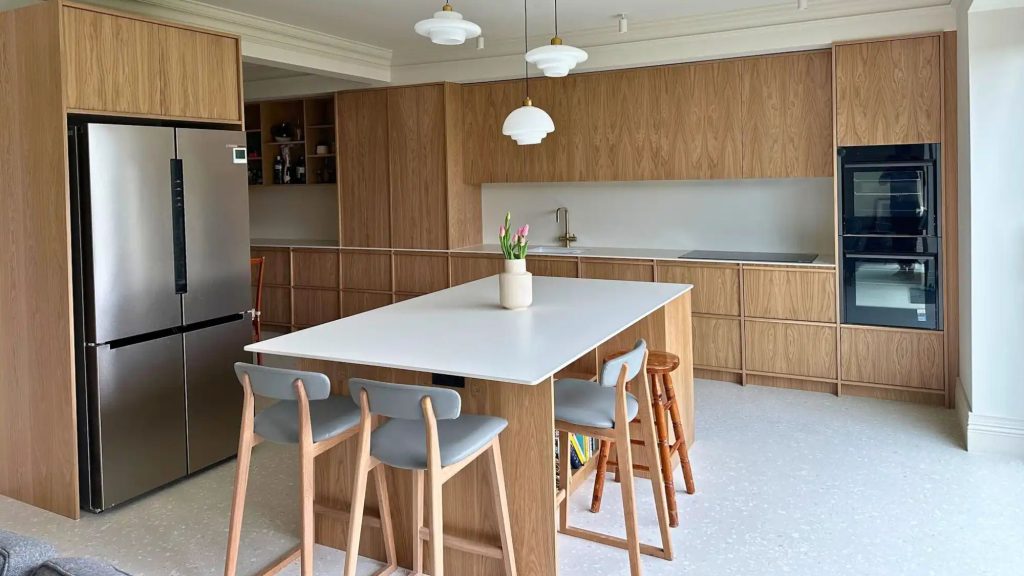
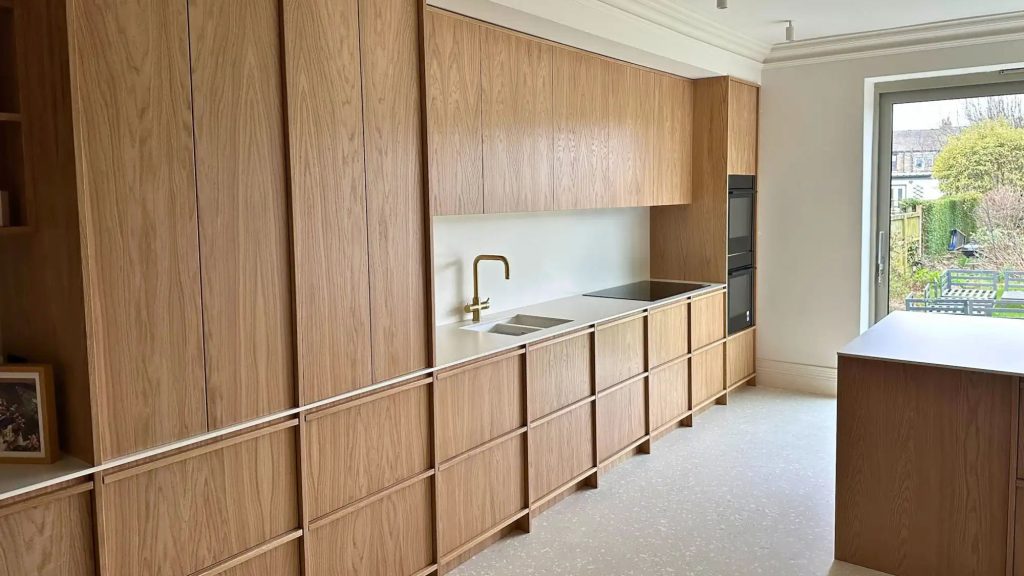
In that Japandi style, oak veneered kitchen, we used oak-veneered fronts with solid oak vertical elements and routed handles across a 7.7-metre main elevation. The challenge was not simply choosing oak. It was controlling how that oak behaved across a very large area.
Door divisions, appliance positions, cabinet heights and grain continuity all had to work together. The visual calm comes as much from those relationships as it does from the material itself.
A beautiful veneer can still look disjointed if every panel reads independently.
Grain Direction Is Part Of The Design
This is why grain should be discussed early.
Whether timber runs vertically or horizontally changes the way cabinetry is perceived. It can emphasise height, length, symmetry or movement across an elevation.
On large veneered doors, sequencing also matters. Adjacent panels should not be treated as isolated rectangles if the intention is for the furniture to read as one composition.
Grain matching, panel divisions and the position of handles or appliances all influence that continuity.
These details can appear minor on a sample board. Across several metres of finished cabinetry, they become much more significant.
Dark Technical Finishes Benefit From A Counterweight
Technical materials such as FENIX can be extremely effective in contemporary kitchens because they allow large areas of cabinetry to remain visually controlled.
But darker finishes need to be considered in relation to everything around them.
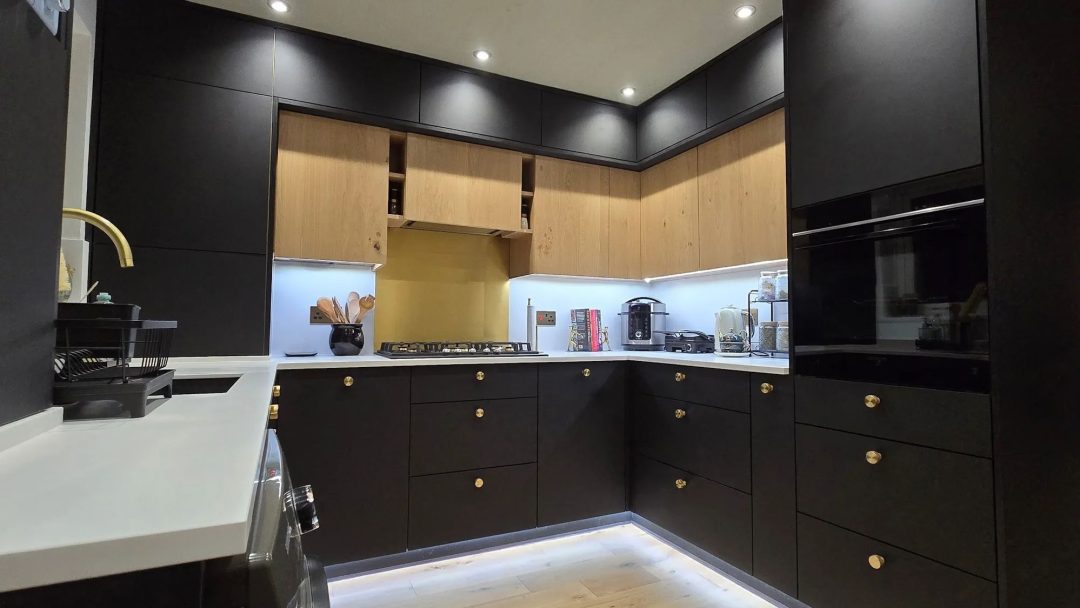
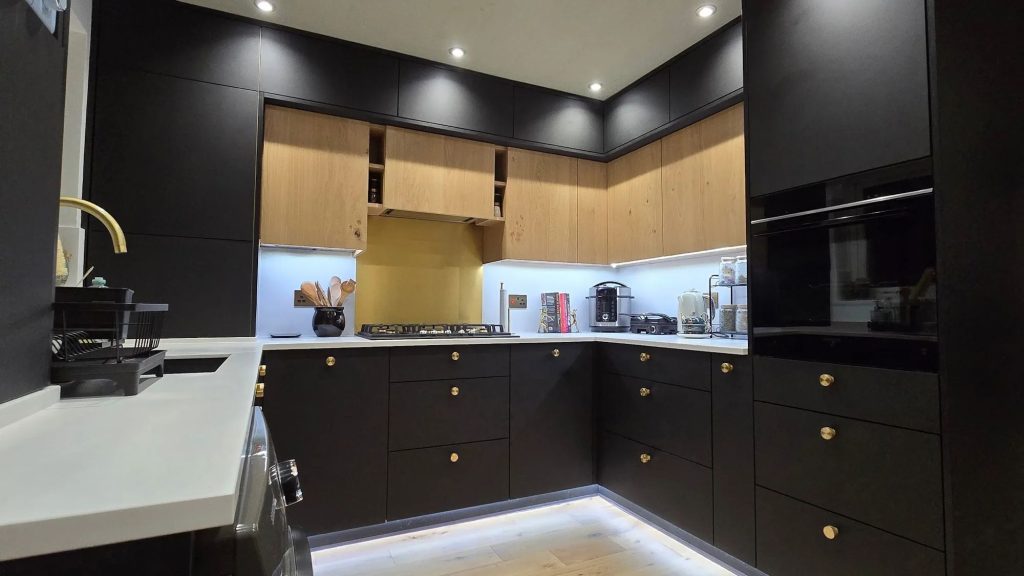
In a bespoke Wakefield kitchen, black FENIX was used on the base and tall cabinetry, while natural oak veneer was reserved for the wall units. White Corian worktops lighten the centre of the composition, with brass introduced as a smaller accent.
The result relies on contrast, but no single material has to carry the entire room.
The oak softens the black. The Corian creates separation between upper and lower cabinetry. The brass adds warmth in a much smaller dose.
That hierarchy is more important than simply assembling a collection of expensive finishes.
Pay Attention To The Transitions
Material changes are often where the quality of a kitchen becomes most visible.
Where does timber stop and another finish begin? How does a worktop meet an end panel? Does a change in material coincide with a cabinet division, architectural junction or change of function?
Good transitions make different materials feel intentional.
Poorly resolved transitions can make even beautiful materials look as though they were selected separately and brought together afterwards.
This is also where bespoke manufacture can make a difference. When cabinet dimensions, panel widths and junctions can be developed around the room rather than dictated by fixed modules, the material composition can be resolved as part of the architecture.
Restraint Is Not About Making A Kitchen Plain
Material restraint should not be confused with removing personality.
It is about allowing the strongest materials and details enough space to be appreciated.
A piece of solid oak can feel more valuable when it is not surrounded by solid oak everywhere. A beautifully sequenced veneer elevation does not need additional decoration to prove its quality. A dark matt cabinet can appear more sophisticated when natural timber or a lighter work surface is used to balance it.
After more than 30 years working with furniture, I have found that refinement often comes from knowing where to stop.
Luxury is not simply the number or cost of materials used. It is the judgement behind where they are placed, how they meet and how they work together as one composition.
Follow us on social media: